
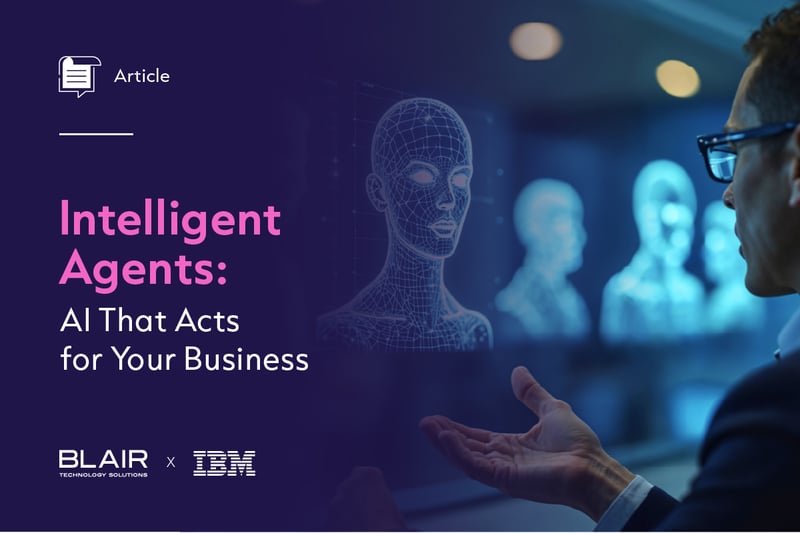
AI, however, is not a single, uniform construct. The term encompasses a diverse set of use cases, models, and methodologies that continue to evolve at a rapid pace. Among these developments, one trend stands out for its growing strategic importance: agentic AI, or intelligent agents.
1. What Exactly Is Agentic AI?The concept of an intelligent agent can quickly become technical, so let’s simplify it.
“Traditional” AI—the kind we use every day, often referred to as generative AI or large language model (LLM) —is fundamentally reactive.
The user asks a question, and the AI provides an answer. It can draft text, explain concepts, or synthesize information, but it does not take initiative. It waits for instructions.
Agentic AI operates on an entirely different level.
It does not merely respond — it acts. It can make decisions, execute sequences of tasks across systems, adapt to changing conditions, and pursue a defined objective with a degree of autonomy.
In practice, an agent can:
- Read an email → analyze the request → create a support ticket → reply to the customer
- Monitor an IT system → detect an incident → run a script → document the intervention
- Extract data → correlate it → generate a report → distribute it to the appropriate recipients
These sequences form what is known as the agentic loop: perceive, decide, act — and continuously iterate while adjusting as needed.

But like any major innovation, adopting and fully understanding it requires time — as well as a certain level of organizational maturity to unlock its full potential.
2. Is Your Organization Mature Enough?
It bears repeating: AI is not magic. Integrating it into your operations is by no means a guarantee of success. Many organizations have attempted to adopt AI too quickly, without the maturity required to support it. The outcome is often the same: misaligned investments, financial losses, and structural issues.
Before implementing any artificial intelligence system, it is essential to ask the right questions:
- What are your business objectives?
- Which departments would benefit most from it?
- What return on investment are you expecting?
At Blair Technology Solutions, we have defined five levels of maturity to assess an organization’s progress in adopting artificial intelligence:
Level 0 – Static Systems
- No reasoning or autonomy
- Responses strictly deterministic based on input
- Simple automation
Level 1 – Reactive AI (Large Language Model without actions)
The model generates a textual response from a prompt, without memory, action capabilities, or interaction with its environment.
Example: conversational chatbot.
Level 2 – Augmented LLM (with tools) / Advanced Automation
The LLM can call external tools such as APIs, databases, or Python scripts.
It takes action, but its autonomy remains limited and tightly controlled.
Level 3 – Autonomous AI Agent
The agent can reason, plan, act, observe, and adjust until it achieves a defined objective.
It possesses:
- Memory
- A level of autonomy
- Decision-making capabilities
Level 4 – Collaborative Agents (Multi-Agent Systems)
Multiple specialized agents interact with one another, enabling:
- Task coordination
- Collective planning
- Information sharing
- Collaborative problem solving
This level paves the way for truly distributed and orchestrated AI systems.
To reach the agentic stage, an organization must rely on five fundamental technological pillars:a. Computing power
b. Intelligent storage
c. Integration infrastructure (APIs, pipelines, orchestration)
d. Observability and governance (monitoring, auditing, drift management)
e. Security and isolation (access management, sandboxing, compliance)
So, is your organization ready to embrace agentic AI?
3. Leveraging Agentic AI to Meet Your Needs
Agentic AI may seem like a significant technological leap. In reality, the transition is far more gradual when guided by a clear framework: connecting systems, structuring actions, and ensuring governance. In this spirit, IBM offers watsonx Orchestrate, a tool designed not to “revolutionize” processes, but to make execution smoother, more coherent, and increasingly autonomous.
Unlike a traditional LLM, which simply responds to questions, the agent acts: it receives an objective, selects the relevant actions, adapts based on intermediate results, and documents each step. It embodies an execution-oriented logic rather than mere content generation.
In practice, Orchestrate enables organizations to:
- Delegate repetitive, time-consuming tasks
- Coordinate multiple actions across disparate systems without complex integrations
- Ensure traceability, auditing, and governance — critical in corporate contexts
- Standardize execution, regardless of the person or team initiating the request
A Practical Example: IBM Automates Its Own Processes
IBM leverages Orchestrate internally, particularly to accelerate recruitment processes. The agent analyzes candidate profiles, updates HR systems, prepares follow-ups, and coordinates between recruiters. Observed results include:
- 40% reduction in administrative time for HR teams
- Faster candidate screening
- Improved consistency in communications
Limitations to Keep in Mind
Agentic AI is not without constraints. An agent remains dependent on:
- The quality and cleanliness of the data
- Clear and well-defined rules to prevent inappropriate actions
- Robust governance to avoid drift, silent errors, or infinite loops
- A sufficiently resilient infrastructure to support autonomous execution
In other words, even the most advanced agent cannot compensate for an organization that is unprepared: KEEP THE HUMAN AT THE CENTER!
At Blair Technology Solutions, we support organizations of all sizes in their transition to AI. We offer tailored training to help identify the tools best suited to your needs, and we provide the expertise of our teams to integrate these solutions effectively within your organization.
If you are ready to take the next step and explore concretely what AI can bring to your operations, schedule a complimentary consultation with our experts to define the next steps together.
Would you like more content related to this topic?
Top 5 Practical Uses of AI Accessible to Canadian SMEs
Cybersecurity: Adapting to the Age of AI